Mainland Southeast Asia · LA
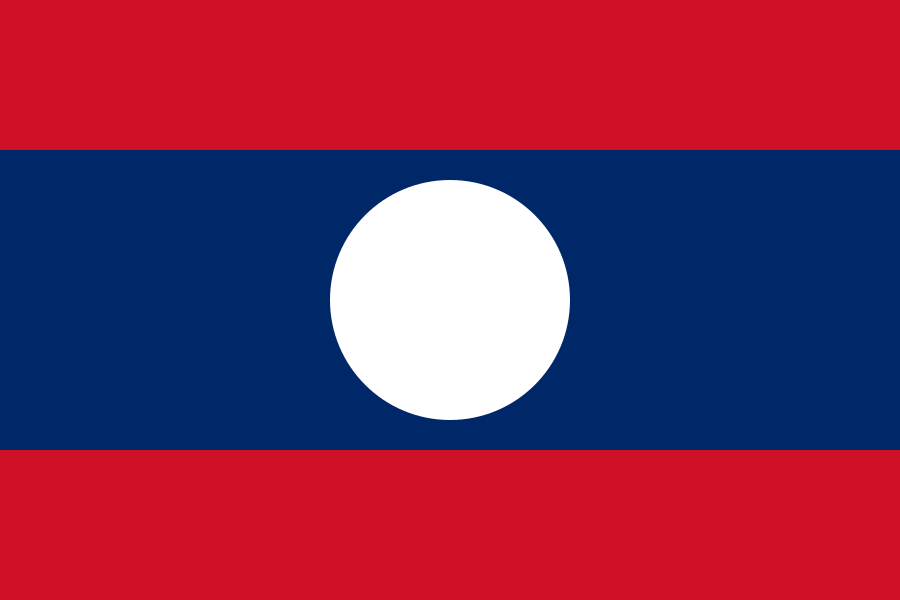
Lao People's Democratic Republic
Landlocked Laos opens new paths for regional solidarity
- Capital ·
- Vientiane
- Population ·
- 7,800,000
- Languages ·
- Lao
Join the solidarity movement
Every contribution — a story, an hour, a partnership — strengthens the network across Southeast Asia.
About Lao People's Democratic Republic
The Lao People's Democratic Republic, commonly Laos, is a landlocked nation of roughly 7.8 million people spread across 236,800 square kilometres of mountainous terrain bordering China, Vietnam, Cambodia, Thailand, and Myanmar. UNData records a youthful demographic profile, with a median age in the mid-twenties and a slowly declining fertility rate as rural communities urbanise around Vientiane. The Mekong River runs through the capital and much of the country's economic life, supporting fisheries, river trade, and the China-Laos Railway that opened in 2021. Ethnic Lao make up roughly half the population, with the remainder comprising Hmong, Khmu, Tai Dam, and other recognised groups whose highland communities have distinct languages and traditions. The Lao economy depends heavily on hydropower exports, mining, and agriculture, with subsistence rice farming still widespread. Laos became a member of ASEAN in 1997 and has benefited from regional integration while remaining one of Southeast Asia's least densely populated countries. Civil society operates within a one-party state framework, so solidarity work is largely coordinated through UN agencies, the ASEAN framework, and international NGOs that partner with government ministries. UXO clearance, maternal health, and ethnic minority language education are priority areas documented by UN OCHA and UNDP.
Latest from Lao People's Democratic Republic
No curated story this week — check back soon.
Organizations working in Lao People's Democratic Republic
Listed organizations are provided for reference. Inclusion here is informational — confirm details before donating or partnering.
- UNHCR Lao PDRVerified partner
Refugee protection
- CARE LaosVerified partner
Food security
- UN OCHA Asia and the PacificVerified partner
Humanitarian coordination
- UNDP Lao PDRListed — not yet verified
Sustainable development
How to support Lao People's Democratic Republic
Sponsor UXO clearance and survivor assistance
Donate to organisations clearing unexploded ordnance from the Indochina conflicts; survivors benefit from prosthetics, microloans, and trauma counselling programmes.
Support Lao maternal and child health programmes
Volunteer or fundraise for rural midwife training, nutrition supplementation, and clean water projects coordinated through UNFPA and UNICEF partners.
Promote ethnic minority language education
Contribute bilingual children's books or partner with NGOs documenting Hmong, Khmu, and Tai Dam oral traditions and folklore.
Back sustainable hydropower research
Donate to or volunteer for environmental impact monitoring of Mekong dams; academic institutions frequently host visiting researchers and citizen scientists.
Neighboring solidarity
Countries that share close regional, linguistic, or historical ties with Lao People's Democratic Republic.